


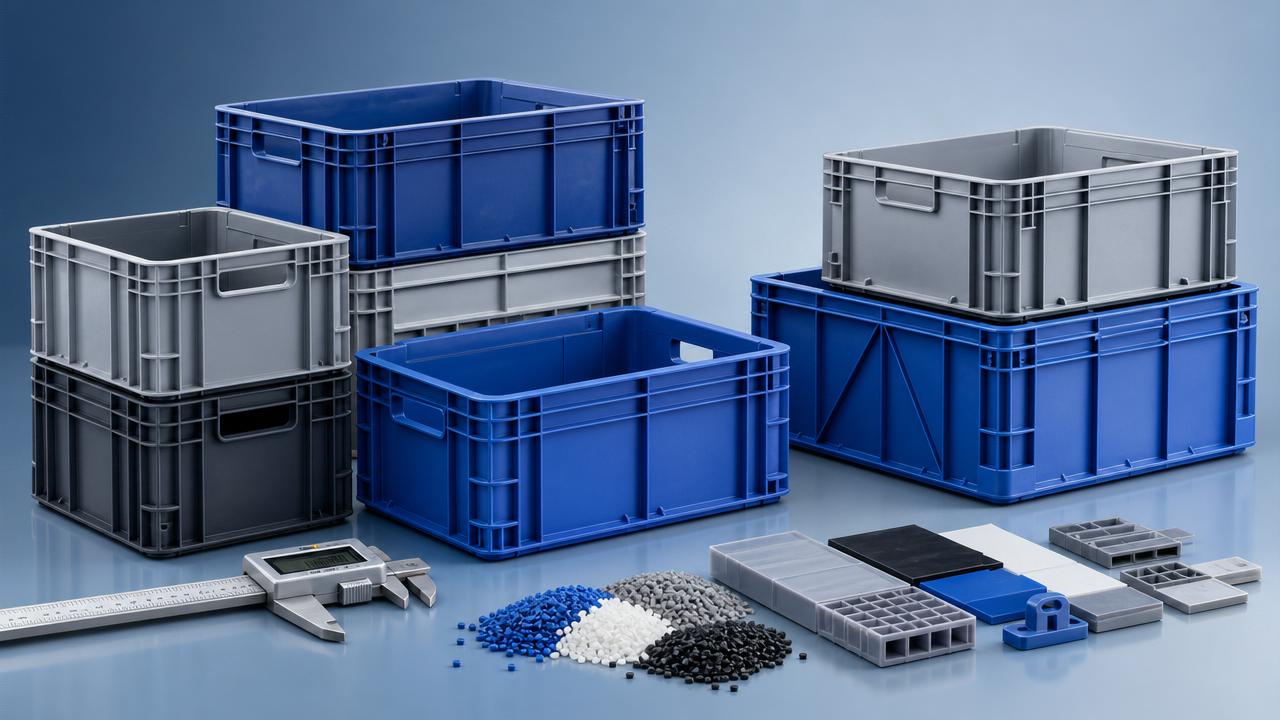
Before placing a bulk order, judging plastic box quality should go far beyond unit price. A low quote can hide weak resin, unstable molding, or poor size consistency.
A good plastic box needs to perform in real handling, stacking, storage, and transport. If it cracks early, deforms under load, or varies between batches, overall cost rises fast.
For sourcing teams, the fastest way to evaluate a plastic box is to combine visual checks, test data, sample use, and supplier process review. That gives a clearer picture before bulk orders.
Shanghai Ximin Industrial Development Co., Ltd. supplies plastic pallets, turnover boxes, baskets, trash cans, water tanks, anti-static products, hollow boards, and other plastic solutions for storage and logistics needs.
Start with the material, not the sample color
The first question is simple: what resin is used in the plastic box? Virgin material, recycled content, and additive ratio all affect strength, smell, brittleness, and lifespan.
Ask for the material type, such as PP or HDPE, and whether UV stabilizers, anti-static agents, or impact modifiers are included. These details matter more than a glossy surface.
- Check whether the plastic box uses virgin resin, mixed resin, or high recycled content. Material transparency from the supplier often predicts stable quality and fewer batch complaints later.
- Rub the inner wall and corners lightly. Strong odor, chalky residue, or greasy feel may suggest poor additives, contamination, or uncontrolled recycled material in production.
- Ask for material test records covering impact resistance, temperature range, and chemical tolerance. A plastic box used in warehousing may fail quickly if resin choice is wrong.
Look closely at molding quality and dimensional consistency
A plastic box can look acceptable at first glance, but poor molding often appears in flash, sink marks, warping, uneven wall thickness, or rough parting lines.
These defects are not cosmetic only. They often signal unstable tooling, inconsistent cooling, or weak quality control, which becomes a bigger problem in large-volume orders.
- Compare several samples side by side. If the plastic box shows visible size variation, lid mismatch, or unstable nesting, large-batch automation and storage efficiency may suffer.
- Inspect corners, handles, ribs, and base supports carefully. These high-stress areas reveal whether molding pressure, cooling time, and wall thickness were properly controlled.
- Measure key dimensions with simple tools. Length, width, height, and inner clearance must match stacking systems, shelves, pallets, and transport layouts without constant adjustment.
Test the plastic box under realistic load conditions
Quoted load capacity should never be accepted without context. Static load, dynamic load, and stacked load are different, and each changes how a plastic box performs.
Run simple tests using the actual product weight and stacking pattern. Even a short in-house trial can reveal base bending, side bulging, or handle weakness.
- Test a loaded plastic box for repeated lifting, dragging, and stacking. One-time strength is not enough; repeated use often exposes hidden brittleness or weak reinforcement.
- If the plastic box will move on pallets or racking, check how the bottom structure behaves. Poor base design can reduce safety even when wall strength seems acceptable.
Match the box design to the real use scene
In logistics use, smooth stacking, forklift handling, and fast turnover usually matter more than surface appearance. A plastic box should fit the whole flow, not only the product.
For food-adjacent, electronic, or clean environments, extra points include easy cleaning, anti-static demand, and contamination control. The right design depends on the real operating scene.
Sometimes it also helps to review compatible handling platforms. For example, warehousing layouts may combine turnover boxes with pallets, including options like 1300X1000 Euro wooden pallet for storage and transport support.
- Confirm whether the plastic box needs lids, drainage holes, solid walls, label areas, or barcode surfaces. Small design details can strongly affect packing speed and traceability.
- Check if the plastic box works with shelves, dollies, pallets, and conveyors already in use. A good box should reduce handling friction, not create new operating steps.
Review production standards and supplier control
A stable plastic box order depends on process control as much as product design. Ask how raw materials are tracked, how molds are maintained, and how finished goods are inspected.
It is also worth checking whether the supplier supports custom sizing, color coding, logo marking, or special performance requirements. Long-term sourcing usually needs that flexibility.
- Request quality records from recent batches, not only a polished brochure. Inspection sheets, tolerance standards, and defect response rules show whether the supplier runs consistently.
- Ask about packaging and shipment protection. A strong plastic box can still arrive scratched, warped, or compressed if bulk packing methods are careless.
- When comparing options, consider related transport tools too. Some projects mix plastic containers with wood support products where affordability and customization are useful in warehouse setups.
Common mistakes that raise total cost
One common mistake is approving a plastic box from one good-looking sample only. Bulk production may behave differently if mold cavities, material batches, or cooling conditions change.
Another mistake is focusing only on purchase price. Replacement frequency, breakage rate, storage mismatch, and return handling often cost more than the initial difference.
- Do not skip small pilot orders. A short trial with real loading, stacking, and transport conditions is usually the fastest way to confirm plastic box quality before expansion.
- Avoid vague specifications such as “strong” or “heavy-duty.” Define resin type, dimensions, tolerances, load data, and inspection rules clearly before placing final purchase orders.
A practical way to make the final judgment
A reliable plastic box should pass four checks: proper material, stable molding, proven load performance, and consistent supplier control. If one area is weak, risk increases quickly.
The simplest next step is to compare samples using one evaluation sheet, then verify findings through a short-use test and supporting production documents. That makes bulk decisions much safer.
When the plastic box fits the application, works with existing logistics tools, and shows repeatable quality, the order is far easier to justify with confidence.
Related Posts
- How to Judge Plastic Box Quality Before Bulk Orders
- Industrial Crate Handling Rules for Safer Daily Operations
- 2026 Industrial Crate Demand and Margin Outlook
- Euro Heavy Duty Plastic Pallet Trends in Cold Storage
- 2026 Durable Euro Plastic Pallet Supply and Lead Time News
- How Plastic Box Ventilation Changes Product Protection
Products
Message

Leave a message
Have any questions or requests? Please leave a message and we will get back to you as soon as possible.