


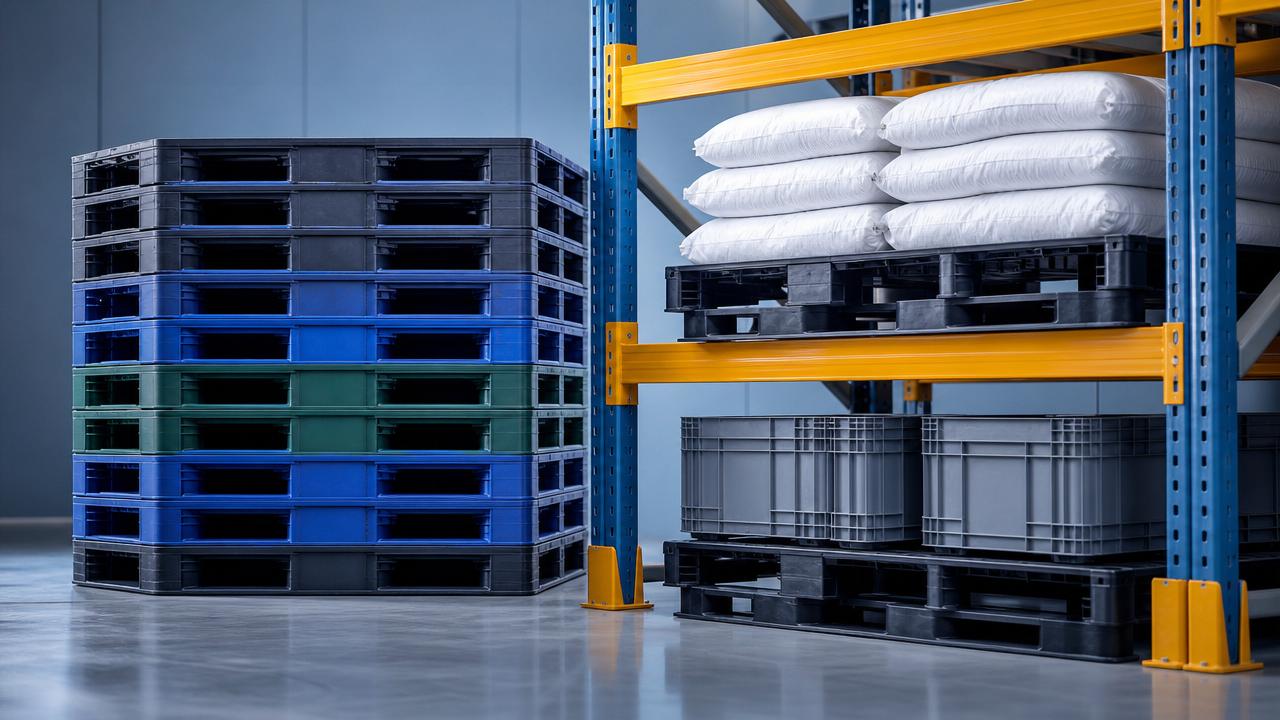
Choosing between a nestable large pallet and a rackable pallet can significantly affect storage density, load stability, and logistics cost. For technical evaluators in the rubber and plastics industry, understanding the structural differences, material performance, and application fit is essential. This guide compares both pallet types to help identify the better solution for your handling, warehousing, and distribution requirements.
What matters most when comparing a nestable large pallet with a rackable pallet?
In rubber and plastics operations, pallets are not just transport accessories. They influence line-side feeding, warehouse slot utilization, forklift safety, return logistics, and packaging consistency. A nestable large pallet is designed to reduce empty-volume occupation, while a rackable pallet is designed to carry loads safely on beam racks.
For technical evaluators, the real question is not which pallet is better in general, but which pallet performs better under actual conditions: static load, dynamic load, racking span, temperature exposure, hygiene requirements, and handling frequency. Material selection and structural design must be reviewed together.
- Choose a nestable large pallet when empty pallet storage efficiency and backhaul cost are major priorities.
- Choose a rackable pallet when beam-rack storage, higher stiffness, and load stability under span are non-negotiable.
- Check whether the pallet will carry resin bags, rubber compounds, molded parts, drums, or boxed components, because load form changes performance requirements.
Structural differences: why the design changes performance
A nestable large pallet usually features a lighter bottom geometry that allows one pallet to fit partially into another. This reduces occupied cubic volume when pallets are empty. In export, returnable distribution, and high-turnover applications, that can lower transport and storage cost substantially.
A rackable pallet normally uses a more rigid deck and reinforced underside. It may include closed runners, stronger beams, or steel reinforcement depending on the application. The purpose is to maintain deflection control and reduce the risk of sagging when loaded across rack beams.
Key engineering differences
- Bottom structure: nestable designs prioritize stackability; rackable designs prioritize span support.
- Weight distribution: rackable pallets usually handle uneven load concentration better.
- Fork entry and handling: both can support forklift or pallet jack access, but bottom design affects compatibility.
- Long-term deformation: rack storage places continuous stress on the pallet body, especially in warm environments.
The comparison below helps technical teams evaluate how a nestable large pallet differs from a rackable type in common industrial criteria.
This table shows why a nestable large pallet is often preferred in distribution loops, while rackable types fit warehouses where palletized rubber or plastic goods spend time on racks rather than on floors or in transit only.
Which pallet fits rubber and plastics industry applications better?
The rubber and plastics industry creates unique load patterns. Bagged polymer resins may be stable but heavy. Injection-molded parts may be light yet volumetric. Rubber sheets, containers, and internal turnover boxes may create uneven point loading. The pallet should match the product profile, not just the nominal load number.
Better applications for a nestable large pallet
- Closed-loop distribution where empty pallets return frequently.
- Short-term floor stacking and cross-docking.
- Operations that prioritize sanitary, washable, and space-saving pallet storage.
Better applications for a rackable pallet
- High-bay warehouses using beam racks.
- Heavier unit loads such as bulk-packed raw materials or dense finished goods.
- Longer storage duration where deflection under load matters.
Shanghai Ximin Industrial Development Co., Ltd. supports technical buyers with plastic pallets, iron pallets, wooden pallets, molded pallets, turnover boxes, and related handling products. This broader product coverage is useful when one pallet type cannot solve every warehouse and transport scenario efficiently.
How should technical evaluators compare load, material, and durability?
A technical review should go beyond brochure values. Static load, dynamic load, and rack load are different metrics. A pallet that performs well on the floor may not perform safely on a rack beam. In plastics processing and rubber product handling, temperature and repeated impact also influence service life.
HDPE and PP are common pallet materials. Their suitability depends on temperature range, impact demand, and load profile. Rib structure, deck design, and reinforcement method can be as important as resin choice. Technical evaluators should request deformation data under expected use conditions whenever possible.
When mixed material handling is required, some companies also keep complementary solutions such as wood-based transport packaging for non-standard or special shipments. For example, Foldable wooden pallet hinged wooden box can be useful in logistics and warehousing where foldability, stacking, and customizable dimensions are needed for specific cargo forms.
The following selection table is designed for technical evaluators choosing between a nestable large pallet and rackable options in real operations.
This approach helps prevent a common mistake: selecting a pallet only by unit price. In many rubber and plastics environments, freight efficiency, damage reduction, and rack compatibility have a greater cost impact than the initial pallet price.
What procurement risks are often overlooked?
Common evaluation mistakes
- Using static load data to judge rack performance. These are not equivalent conditions.
- Ignoring real load distribution. Bagged material, drums, bins, and boxed parts stress the deck differently.
- Overlooking empty pallet reverse logistics. This is where a nestable large pallet often creates measurable savings.
- Failing to verify compatibility with forklifts, pallet jacks, conveyors, or automated handling paths.
- Not considering sanitation, washability, or contamination control for sensitive plastic products.
Technical evaluators should also review dimensional consistency, slip resistance, deck openness, and edge design. In molding, compounding, and warehousing operations, these details affect handling stability and operator safety more than many buyers expect.
FAQ: practical questions before choosing a nestable large pallet
Is a nestable large pallet suitable for heavy industrial loads?
It can be, but suitability depends on dynamic load, load distribution, and whether racking is involved. For floor transport and short dwell time, a nestable large pallet may perform well. For heavy rack storage, a rackable pallet is usually the safer engineering choice.
When does a rackable pallet justify its higher structural complexity?
It becomes worthwhile when your warehouse relies on beam racks, your loads are dense, or product damage from deflection would be costly. In such cases, higher structural rigidity can reduce operational risk and improve storage confidence.
Can one company use both pallet types?
Yes. Many rubber and plastics manufacturers use rackable pallets in warehouse storage and a nestable large pallet in outbound or return logistics. A mixed strategy often delivers better economics than forcing one design into every task.
What dimensions are commonly reviewed for complementary packaging solutions?
Besides standard pallet footprints, technical buyers may also review special formats such as 1200*800 or 1100*1100 for wooden or foldable transport units. If fragile or irregular goods are involved, solutions like the Foldable wooden pallet hinged wooden box may support customized handling and recyclable packaging needs.
Why choose us for pallet selection and project support?
Shanghai Ximin Industrial Development Co., Ltd. serves buyers who need more than a standard catalog answer. Because the company covers plastic pallets, iron pallets, wooden pallets, molded pallets, turnover boxes, trash cans, tanks, hollow boards, and related industrial products, technical evaluators can compare alternatives based on application rather than forcing a single material route.
If you are assessing a nestable large pallet for resin handling, finished goods shipment, or internal warehouse turnover, you can consult on key points before ordering:
- Load condition confirmation, including static, dynamic, and rack-use requirements.
- Product selection between nestable, rackable, wooden, or mixed packaging solutions.
- Dimension matching for your storage system, container loading plan, and transport method.
- Delivery schedule review, sample support, and customization discussion for special cargo.
- General compliance and application guidance aligned with your industry handling conditions.
If your team is deciding whether a nestable large pallet or a rackable pallet fits better, a practical evaluation based on load profile, warehouse method, and return-loop economics will produce the clearest answer. Contact us to review parameters, compare options, discuss lead time, and request a solution that matches your actual rubber and plastics workflow.
Related Posts
- Nestable Large Pallet or Rackable Type: Which Fits Better
- When a Heavy Duty Large Pallet Lowers Warehouse Damage Risk
- Heavy Duty Large Pallet Trends Shaping 2026 Material Handling
- When Does a Stackable Large Pallet Save More Floor Space?
- What Affects the Real Lifespan of a Stackable Large Pallet?
- Stackable Large Pallet Load Ratings That Are Easy to Misread
Products
Message

Leave a message
Have any questions or requests? Please leave a message and we will get back to you as soon as possible.