


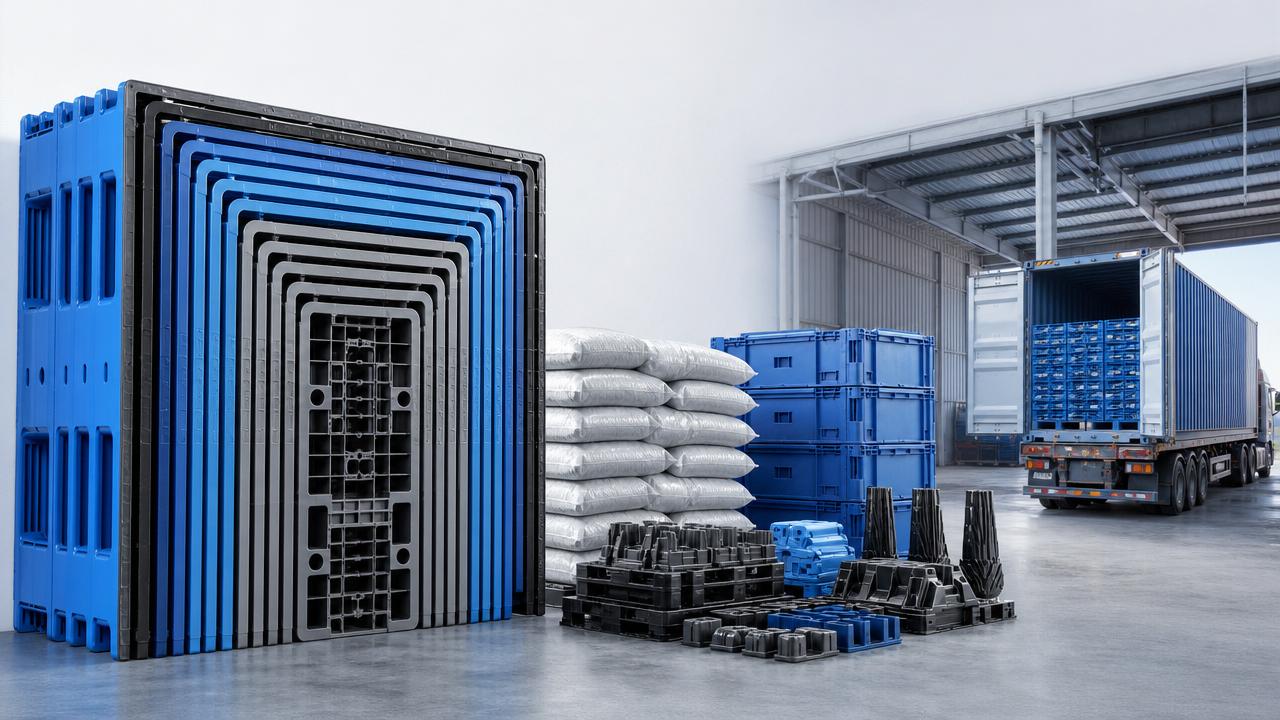
For finance decision-makers, a nestable large pallet offers value far beyond saving floor space. Lower return freight, reduced storage costs, longer service life, and improved handling efficiency can all translate into measurable cost advantages across the supply chain. Understanding these broader financial benefits helps businesses make smarter pallet investments with stronger long-term returns.
Understanding the Role of a Nestable Large Pallet
A nestable large pallet is designed so empty units fit into each other. This reduces the footprint required during storage, return transport, and staging.
In the rubber and plastics industry, pallet efficiency matters because movement volumes are high. Resin bags, molded parts, containers, and components often circulate continuously.
Compared with conventional rigid platforms, a nestable large pallet can improve logistics density. That change affects cost structure across warehousing, handling, and transport operations.
Shanghai Ximin Industrial Development Co., Ltd. supplies plastic pallets and related handling products. This broader product experience supports practical pallet selection for industrial circulation needs.
Current Cost Pressures Across Industrial Logistics
Today, pallet decisions are influenced by more than unit purchase price. Total cost now includes transport utilization, labor productivity, replacement frequency, and hygiene compliance.
- Rising warehouse rent increases the value of compact empty-pallet storage.
- Higher fuel and freight rates reward better trailer and container utilization.
- Labor constraints make stable handling and fast movement more important.
- Sustainability targets favor reusable pallet systems with longer service life.
For this reason, the nestable large pallet is often evaluated as a financial tool, not just a storage accessory.
Where the Main Cost Benefits Come From
1. Lower Empty Return Freight
The strongest advantage of a nestable large pallet appears after delivery. Empty pallets returning from customers or distribution points occupy far less trailer space.
That means more units per return trip, fewer transport cycles, and better fuel efficiency. For closed-loop distribution, the savings can be recurring and highly visible.
2. Reduced Storage Cost
When empty pallets nest, warehouse lanes and staging zones remain available for productive inventory. This improves site utilization without facility expansion.
A nestable large pallet can therefore support lower off-site storage demand and reduce pressure on internal floor planning.
3. Longer Lifecycle Value
Well-designed plastic pallets resist moisture, many chemicals, and routine washdown. In rubber and plastics operations, that durability supports stable long-term use.
A lower breakage rate means fewer replacements, less product damage, and more predictable budgeting over time.
4. Better Handling Efficiency
Consistent dimensions and molded structure improve compatibility with forklifts, pallet jacks, conveyors, and automated flows. Faster movement lowers labor time per load handled.
This benefit is especially relevant where throughput speed influences shipping performance and dock utilization.
Comparing Financial Impact Areas
Application Value in Real Industrial Scenarios
The nestable large pallet is useful in several common environments within the rubber and plastics supply chain.
- Raw material distribution for resin bags and packaged additives.
- Internal transfer of molded parts between production and assembly.
- Export and domestic warehousing with frequent pallet repositioning.
- Closed-loop delivery systems serving recurring shipment routes.
In some mixed-material operations, companies may also compare plastic and wood solutions. For certain logistics or warehousing needs, Competitive Price Cp8 Wooden Pallet From Direct Vietnam'S Factory Natural Wood Pallet can serve as a reference option.
That CP8 model uses natural wood, supports collection, stacking, and transportation, and offers an affordable customizable alternative in selected scenarios.
Selection Considerations Beyond Purchase Price
A nestable large pallet should be evaluated using total cost of ownership rather than initial invoice value alone.
- Check dynamic load, static load, and racking requirements.
- Match pallet dimensions to containers, trucks, and storage systems.
- Review cycle frequency and expected return distances.
- Estimate cleaning, maintenance, and loss rates.
- Assess compatibility with automation and hygiene expectations.
This approach reveals whether a nestable large pallet creates stronger annual savings than a lower-priced but shorter-lived alternative.
Practical Implementation Advice
Start with route-level analysis. Measure empty return ratios, average storage days, pallet damage rates, and loading density before making a broad switch.
Then run a pilot in one warehouse or transport loop. Compare freight, labor time, damage claims, and space utilization over a defined period.
Where product mix varies, maintain a pallet portfolio. A nestable large pallet may fit high-circulation flows, while other pallet formats support special loads or export needs.
It can also be useful to benchmark plastic systems against products such as Competitive Price Cp8 Wooden Pallet From Direct Vietnam'S Factory Natural Wood Pallet when balancing cost, durability, and application conditions.
Conclusion and Next Step
A nestable large pallet delivers financial benefits that extend well beyond floor space reduction. It can cut empty return freight, improve warehouse efficiency, support long service life, and streamline handling.
In the rubber and plastics sector, these advantages often produce measurable total-cost improvements across the full logistics cycle.
The next practical step is to review current pallet circulation data, identify high-volume return routes, and compare lifecycle economics across material options before standardizing procurement.
Related Posts
- Nestable Large Pallet Cost Benefits Beyond Floor Space
- What to Check Before Ordering a Nestable Large Pallet
- Where Wooden Pallet Price Pressure Is Hitting Distributors
- Can Wooden Pallet Price Predict Maintenance Costs Later
- Wooden Pallet Price Benchmarks by Size and Load Class
- How Wooden Pallet Price Affects Packaging Budgets
Products
Message

Leave a message
Have any questions or requests? Please leave a message and we will get back to you as soon as possible.