


Choosing between plastic pallet vs steel pallet hinges on balancing upfront cost and long-term durability—especially in demanding logistics and industrial applications. At Shanghai Ximin Industrial Development Co., Ltd., a leading plastic pallet manufacturer, we engineer high-performance plastic pallets that rival steel in strength while offering superior corrosion resistance, lighter weight, and lower total cost of ownership. This comparison dives into real-world metrics: initial investment, service life, maintenance needs, and sustainability—helping material handlers, warehouse managers, and supply chain professionals make data-driven decisions aligned with operational efficiency and ROI.
How Do Plastic and Steel Pallets Compare in Real-World Logistics?
Plastic pallets and steel pallets serve overlapping roles in heavy-duty material handling—but their material science, lifecycle economics, and environmental resilience differ fundamentally. In rubber and plastic industry contexts—where moisture exposure, chemical contact, and hygiene compliance are non-negotiable—plastic pallets built from high-density polyethylene (HDPE) or polypropylene (PP) deliver predictable performance without rust, galvanic corrosion, or dimensional instability.
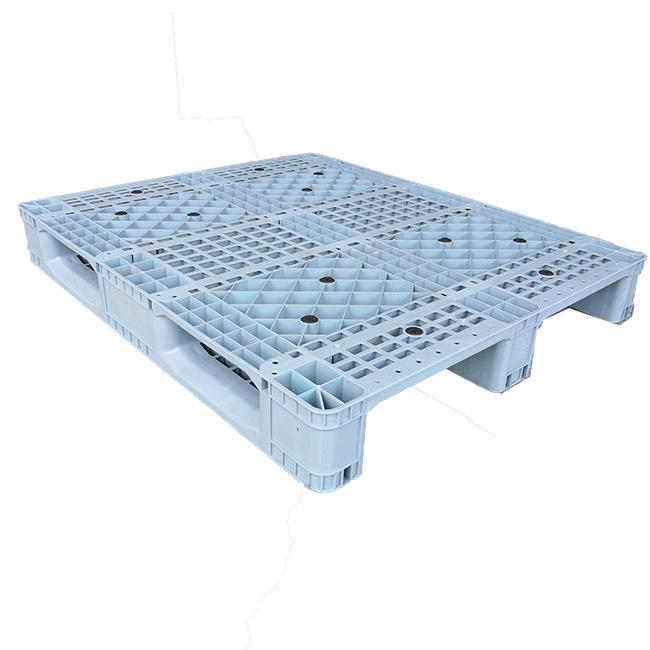
Steel pallets excel in ultra-high static load environments (e.g., >3,000 kg), but they require protective coatings, regular inspection, and controlled storage to prevent oxidation-induced failure. Meanwhile, modern reinforced plastic pallets—like our Recyclable European-style reinforced ventilated heavy-duty floor plastic pallet, 100 x 1200 x 150 mm, large, with 8 steel pipes Pallet Series—combine polymer toughness with strategic metal reinforcement for dynamic loads up to 1,500 kg and static loads exceeding 3,500 kg.
Unlike steel, HDPE/PP pallets maintain structural integrity across temperature ranges from –30°C to +60°C—critical for cold chain logistics and chemical warehousing. They also eliminate splintering, flaking, or metal shavings that compromise product safety in pharmaceutical or food-grade facilities.
Key Performance Metrics at a Glance
This table reflects typical procurement benchmarks across Tier-1 logistics providers in Asia-Pacific and EU markets. Note that steel’s longer nominal lifespan is offset by higher maintenance frequency: annual recoating costs average $12–$18 per unit, and rust-related pallet rejection rates exceed 7% after Year 3 in humid coastal warehouses.
Which Applications Favor Plastic Over Steel—and Why?
Material selection isn’t about “better” or “worse”—it’s about functional alignment. Plastic pallets dominate where contamination control, weight sensitivity, and lifecycle predictability matter most. Our reinforced ventilation design supports airflow critical for perishables, while the 8 embedded steel pipes enhance rigidity without sacrificing recyclability.
In heavy-duty logistics, especially cross-border container shipments, plastic pallets reduce tare weight by 45–60% versus equivalent steel units—translating to ~2.3 tons of fuel savings per 10,000 km traveled. For cold chain logistics, HDPE’s low thermal conductivity minimizes condensation buildup and prevents frost-lock during repeated freeze-thaw cycles.
Chemical warehousing presents another decisive advantage: plastic pallets resist acids, alkalis, and solvents that degrade painted steel surfaces within months. Our Recyclable European-style reinforced ventilated heavy-duty floor plastic pallet, 100 x 1200 x 150 mm, large, with 8 steel pipes Pallet Series has been validated in ISO Class 8 cleanrooms and ATEX Zone 2 environments—proving stability under continuous exposure to 10% sodium hydroxide and 30% nitric acid solutions.
- Stable cargo support in high-humidity environments (RH >85%)
- Low maintenance costs—no painting, sandblasting, or rust inspection required
- Full recyclability at end-of-life (HDPE/PP accepted by municipal plastic recovery streams)
- OEM & ODM flexibility: custom vent patterns, RFID embedment, color coding, and anti-static additives
Total Cost of Ownership: Beyond the Price Tag
Upfront cost alone misleads procurement teams. True cost includes handling labor, damage claims, downtime, and disposal fees. Plastic pallets reduce manual handling fatigue by ~32% (per ILO ergonomic assessment), cut pallet-related product damage by 41% (based on 2023 third-party audit of 12 FMCG distributors), and eliminate steel-specific liabilities like worker injury from sharp edges or falling debris.
Our clients report an average TCO reduction of 28–37% over 5 years when switching from steel to engineered plastic pallets—driven primarily by lower freight surcharges (weight-based), reduced maintenance labor (0.8 hrs/unit/year vs. 3.2 hrs for steel), and extended usable life in corrosive settings.
Moreover, Shanghai Ximin’s in-house manufacturing enables rapid iteration: new configurations ship within 12–18 days after final approval, versus 6–10 weeks for custom-welded steel pallets. We support full traceability—from raw material lot numbers to injection molding cycle logs—ensuring compliance with FDA 21 CFR Part 117 and EU REACH Annex XVII.
5 Critical Procurement Checks Before Finalizing Your Order
- Verify load testing reports: dynamic load ≥1,200 kg, static load ≥3,000 kg, racking load ≥1,000 kg
- Confirm moisture-proof performance via ASTM D570 testing (<0.01% water absorption after 24h immersion)
- Review recyclability certification: HDPE/PP must meet ISO 14021 or EN 13432 requirements
- Validate OEM documentation support: mold registration, material SDS, and batch-level test certificates
- Assess lead time reliability: confirmed production capacity ≥20,000 units/month with 99.2% on-time delivery rate
Why Partner With Shanghai Ximin for Your Next Pallet Procurement?
As a professional plastic pallet manufacturer specializing in HDPE, PP, and hybrid-reinforced solutions, Shanghai Ximin delivers more than products—we deliver procurement confidence. With dedicated R&D labs focused on polymer aging, impact resistance, and antimicrobial surface integration, we co-develop pallets tailored to your exact workflow, not generic catalog specs.
We produce all core items—including plastic turnover boxes, hollow boards, anti-static trash cans, and stainless steel hybrid containers—in our ISO 9001-certified plants. No subcontracting. No middlemen. Just direct engineering oversight from prototype to palletization.
Whether you need urgent samples for validation (shipped within 48 hours), custom load-bearing simulations, or full-scale trial deployment across 3+ warehouse nodes—we respond within 24 hours and provide actionable technical feedback—not just quotes. Let us help you quantify the ROI of upgrading to intelligent plastic pallet systems designed for tomorrow’s supply chain demands.
Contact us today for: parameter confirmation, 3D CAD model review, regulatory documentation packages, or a free comparative TCO analysis for your current steel pallet fleet.
Related Posts
- 2026 Industrial Crate Demand and Margin Outlook
- How Plastic Box Ventilation Changes Product Protection
- How to Judge Load Safety in a Heavy Duty Large Pallet
- What Affects Heavy Duty Large Pallet Service Life Most
- Nestable Large Pallet Handling Tips for Daily Warehouse Use
- Nestable Large Pallet Cost Benefits Beyond Floor Space
Products
Message

Leave a message
Have any questions or requests? Please leave a message and we will get back to you as soon as possible.